Showing posts with label poisonous. Show all posts

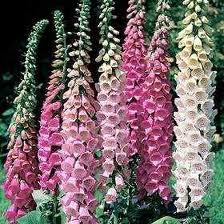
Digitalis - Foxglove


Latin plant name Digitalis
Common plant name Foxglove
Plant type Herbaceous perennial shrub
Size (meters) <50-255 cm
Distinguishing features The scientific name means "finger-like" and refers to the ease with which a flower of Digitalis purpurea can be fitted over a human fingertip. The flowers are produced on a tall spike, are tubular, and vary in colour with species, from purple to pink, white, and yellow.

A group of medicines extracted from foxglove plants are called Digitalin.

Digitalis toxicity (Digitalis intoxication) results from an overdose of digitalis and causes anorexia, nausea, vomiting and diarrhoea, as well as sometimes resulting in xanthopsia (jaundiced or yellow vision) and the appearance of blurred outlines (halos). Bradycardia also occurs. Because a frequent side effect of digitalis is reduction of appetite, some individuals have used the drug as a weight-loss aid.

Laburnum - Golden chain


Latin plant name Laburnum
Common plant name Golden chain
Plant type Decidious tree
Size (meters) < 2 m
Distinguishing features All parts of the plant are poisonous, and can be lethal if consumed in excess. Symptoms of laburnum poisoning may include intense sleepiness, vomiting, convulsive movements, coma, slight frothing at the mouth and unequally dilated pupils. In some cases, diarrhea is very severe, and at times the convulsions are markedly tetanic. The main toxin in the plant is cytisine, a nicotinic receptor agonist.

They have yellow pea-flowers in pendulous racemes 10–30 cm (4–12 in) long in spring, which makes them very popular garden trees.

Prunus laurocerasus - Cherry laurel


Latin plant name Prunus laurocerasus
Common plant name Cherry laurel
Plant type Evergreen shrub
Size (meters) < 2 m
Distinguishing features It flowers in April, with white spiky florets growing along stems up to 10 cms long. These are followed by small black fruits. The fruits are poisonous for dogs.

This is a very useful shrub for hedging and screening since it is dense and fast-growing.

Although the common names of Prunus laurocerasus refer to the similarity of foliage and appearance to bay laurel (Laurus nobilis, the true laurel, in the Lauraceae family), the two plants are in fact unrelated, being not only in different genera but also different families.

Viburnum davidii


Latin plant name Viburnum davidii
Common plant name Viburnum
Plant type Woody evergreen shrub
Size (meters) < 2 m
Distinguishing features The flowers are produced in corymbs 5–15 cm across, each flower white to cream or pink, small, 3–5 mm across, with five petals, strongly fragrant in some species.

The fruit is a spherical, oval or somewhat flattened drupe, red to purple, blue, or black, and containing a single seed; some are mildly poisonous to people.

Lonicera - Honeysuckle


Latin plant name Lonicera periclymenum
Common plant name Honeysuckle (madreselva)
Plant type Climbing shrub
Size (meters) Up to several meters
Distinguishing features Green leaves with corrugated cream tips. Blue winter flowers which nectar is edible. The flowers attract hummingbirds. The berries are mildly poisonous. 

Taxus baccata - Yew tree


Latin plant name Taxus baccata
Common plant name Yew tree
Plant type Conifer tree 
Size (meters) 10 - 20 m
Distinguishing features
The trunk can be up to 2 metres (exceptionally 4 m) diameter. The bark is thin, scaly brown, coming off in small flakes aligned with the stem. The leaves are lanceolate, flat, dark green, 1–4 centimetres long and 2–3 millimetres broad, arranged spirally on the stem, but with the leaf bases twisted to align the leaves in two flat rows either side of the stem,

It is relatively slow growing, and can be very long-lived, with the maximum recorded trunk diameter of 4 metres probably only being reached in about 2,000 years.

It is considered by several authors that the oldest yew tree in Spain is located in Bermiego,Asturias. It is known as 'Teixu l'Iglesia' in the Asturian language. It is 15 metres tall with a trunk perimeter of 6 metres and a crown diameter of 10 metres. It was planted around 1160. It was declared Natural Monument on April 27, 1995 by the Asturian Government and is protected by the Plan of Natural Resources.

Most parts of the tree are toxic, except the bright red aril surrounding the seed, enabling ingestion and dispersal by birds. The major toxin is the alkaloid taxane. The foliage remains toxic even when wilted or dried. Horses have the lowest tolerance, with a lethal dose of 200–400 mg/kg body weight, but cattle, pigs, and other livestock are only slightly less vulnerable. Symptoms include staggering gait, muscle tremors, convulsions, collapse, difficulty breathing, coldness and eventually heart failure. However, death occurs so rapidly that many times the symptoms are missed. Fatal poisoning in humans is very rare, only occurring after eating a lot of yew foliage. The lethal dose is reported to be between 50 and 100 grams.The wood is also poisonous.

There aren't weeds beneath the yew trees because the roots are also poisonous.

In the ancient Celtic world, the yew tree (*eburos) had extraordinary importance; a passage by Caesar narrates that Catuvolcus, chief of the Eburones poisoned himself with yew rather than submit to Rome (Gallic Wars 6: 31). 

The yew is often found in churchyards in England, Wales, Scotland, Ireland and France. In Ireland it is called the death tree.

Yew is the wood of choice for longbow making; the bows are constructed so that the heartwood of yew is on the inside of the bow while the sapwood is on the outside. This takes advantage of the natural properties of yew wood since the heartwood resists compression while the sapwood resists stretching.

In latin the termination 'xus' gives the indication of its use in medicine.

Taxol is a medicine use to treat cancer and it is extracter from the yew tree.