Showing posts with label hedging. Show all posts

School hedge

We have planted a hedge to give some shelter to the school orchard.

We used:

That is a total of 62 plants that will allow as to have a double row of 31 plants each.

The lenght of the hedge is 6meters+15 meters that makes a total of 19 meters.

19/31=0.6m=2 feet

The distance between the plants will be of 2 feet in each of the two rows with a gap of 1 foot in between both rows.

With a string and some pegs we marked the position of each of the plants on each of the two rows.

We divided into three groups, one will dig square holes, the other will do round holes with the auger and the last will dig a trench.

TRENCH WORK


AUGER HOLES


SQUARE HOLES


Planting a hedge

A hedge can be planted to create shelter for the beds of a veg garden or an orchard.

To plant the hedge we will:
  1. Clear the surface
  2. Distribute the plants along the surface
  3. Prepare the planting holes
  4. Plant the trees
To clear the surface we will need:
  • Strimmer
  • Hedge clippers
  • Spade
  • Lawnmower
  • Knapsack sprayer (after 10 days of clearing the surface)
To prepare the planting hole we will need:
  • Auger
  • Spade
  • Shovel
  • Wheelbarrow
  • Measuring tape
  • Post and wire
  • String and pegs to get them into a line
The holes could be done:
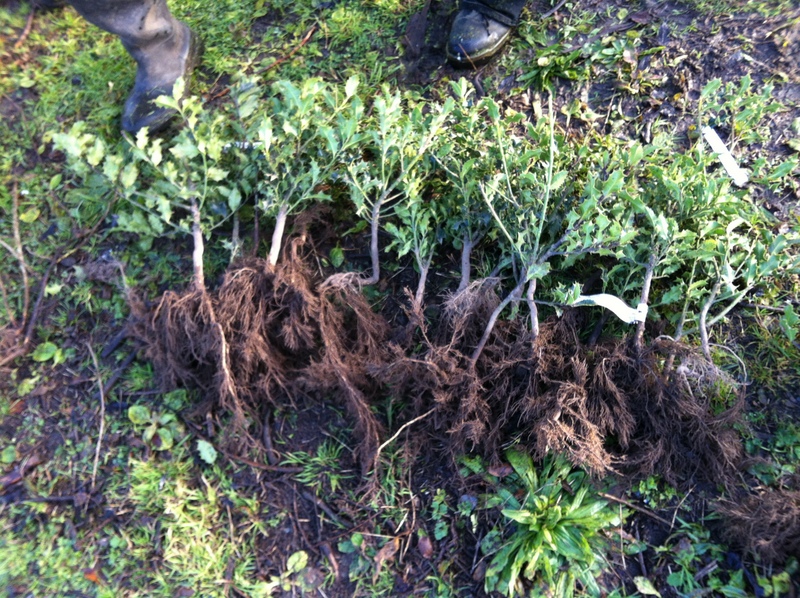
  1. Trench: It is the old method so it will take longer to prepare. Once the trench is been digged put some compost and lay the bareroot plants on the trench. Put back the soil that had been taken out from the trench and make the trees stand upwards. Press the soil around the tree.
  2. Square holes: Dig a square hole bigger than the pot we are planting. Place some compost on the bottom of the hole and then place the tree. Fill the hole with soil and press around the tree to compact the soil and avoid air getting into the roots.
  3. T cuts: Make a T-cut with the spade and slide the roots of the tree from the side so the roots are in the right position. It is the method that will give the minimal disturbance to the soil. It will not bring new weeds.
  4. Auger: A round hole is not ideal because it can cause the roots go circular and die. The benefit from an auger is the speed and that is the reason why it is used by most of the gardeners.

Leylandis


Latin plant name Cupressus x leylandii
Common plant name Leylandii
Plant type Coniferous evergreen tree
Size (meters) < 15 m
Distinguishing features Rapid and thick growing.

Leyland Cypress is light-demanding but is tolerant of high levels of pollution and salt spray. A hardy, fast-growing natural hybrid, it thrives on a variety of soils and sites are commonly planted in gardens to provide a quick boundary or shelter hedge, because of their rapid growth. Although widely used for screening, it has not been planted much for forestry purposes.

Photinia fraseri - Red robbin


Latin plant name Photinia fraseri
Common plant name Red robbin
Plant type Evergreen shrub
Size (meters) < 2 m
Distinguishing features Photinias typically grow from 3–15 m tall, with a usually irregular crown of angular branches; the branches are often (not always) thorny. The leaves are alternate, entire or finely toothed.

The majority of species are evergreen but several are deciduous. The flowers are produced in early summer in dense terminal corymbs; each flower is 5–10 mm diameter, with five rounded white petals; they have a mild, hawthorn-like scent.

The fruit is a small pome, 4–12 mm across, bright red and berry-like.

Buxus sempervirens - Boxwood


Latin plant name Buxus sempervirens
Common plant name Boxwood
Plant type Woody evergreen shrub
Size (meters) < 35 m
Distinguishing features Arranged in opposite pairs along the stems, the leaves are green to yellow-green.

Slow growth of box renders the wood ("boxwood") very hard (possibly the hardest in Europe) and heavy, and free of grain produced by growth rings, making it ideal for cabinet-making, the crafting of clarinets, engraving, marquetry, woodturning, tool handles, mallet heads and as a substitute for ivory.

It was used for the propellers in I World War.

The biggest boxwood trees (35m) are found in Ireland because they were not cut down during the war.

Lonicera periclymenun - Privet


Latin plant name Lonicera periclymenun
Common plant name Privet
Plant type Shrub
Size (meters) < 2 m
Distinguishing features Ideal for hedges.

Cotoneaster


Latin plant name Cotoneaster
Common plant name Cotoneaster
Plant type Semievergreen woody shrub
Size (meters) < 5 m
Distinguishing features The leaves are arranged alternately, 0.5–15 centimetres (0.20–5.9 in) long, ovate to lanceolate, entire; both evergreen and deciduous species occur.

The flower is either fully open or has its five petals half open 5–10 millimetres (0.20–0.39 in) diameter. They may be any shade from white through creamy white to light pink to dark pink to almost red,

The fruit is a small pome 5–12 millimetres diameter, pink or bright red, orange or even maroon or black when mature, containing one to three seeds. Fruit on some species stays on until the following year.

The flowers attract bees and butterflies and the fruits are eaten by birds.

They are used as a valuable source of nectar when often the bees have little other forage in the June Gap. The red berries are also highly attractive to blackbirds and other thrushes.

Thuja


Latin plant name Thuja 
Common plant name Thuja
Plant type Evergreen tree
Size (meters) < 3 m
Distinguishing features The leaves are arranged in flattened fan shaped groupings with resin-glands, and oppositely grouped in 4 ranks.

The mature leaves are different from younger leaves, with those on larger branchlets having sharp, erect, free apices.

Several species are widely known as cedar but because they are not true cedars (Cedrus) it has been recommended to call them redcedars or whitecedars.

Laurus novelis - Bay laurel


Latin plant name Laurus novelis
Common plant name Bay laurel
Plant type Hedge evergreen shrub
Size (meters) < 1,5 m
Distinguishing features Dark ornamental leaves.

Yellow flowers in spring followed by green and then black fruits.

It is idea for shapping but needs to keep trimming it.

Bay is widely cultivated as an ornamental plant. It is used to create single erect stems with ball-shaped, box-shaped or twisted crowns; also for low hedges.

Laurel oil is a main ingredient, and the distinguishing characteristic of Aleppo soap. Aleppo soap is revered worldwide for its skin care properties.

The plant is the source of several popular spices used in a wide variety of recipes, particularly among Mediterranean cuisines.

Lonicera nitida - Poorman's box


Latin plant name Lonicera nitida
Common plant name Poorman's box
Plant type Perennial Shrub
Size (meters) < 1 m
Distinguishing features The species is a broadleaf evergreen shrub.

The leaves are dark green and 6–16 millimeters long.

The flowers are creamy white, fragrant, 6 millimeters long, and grow in pairs. They appear at the end of spring. The fruit (rarely formed on clipped specimens) is an inedible bluish-purple berry about 6 millimeters in diameter.

The growth rate is moderate or fast growing.

The species is resistant to deer and rabbits. Birds are attracted to the species.

The species is commonly confused with cotoneaster species. The difference between the two is that cotoneaster has alternate leaves while this species has opposite leaves.

True Geranius - Cranesbill


Latin plant name Geranium
Common plant name Cranesbill
Plant type Hardy herbaceous flowering plant
Size (meters) < 0,5 m
Distinguishing features The long, palmately cleft leaves are broadly circular in form. The flowers have five petals and are coloured white, pink, purple or blue, often with distinctive veining. Geraniums will grow in any soil as long as it is not waterlogged. Propagation is by semiripe cuttings in summer, by seed, or by division in autumn or spring.

They are perect for hedges.

Ilex x meserveae - Blue holly


Latin plant name Ilex x meserveae
Common plant name Blue holly
Plant type Woody evergreen shrub
Size (meters) < 2 m
Distinguishing features Cultivated holly from Germany. It doesn't have berries and the leaves are not prickly. Low maintenance. It can stand very low temperatures. Ideal for hedging. When the leaves are very light it means that they are not doing the photosynthesis.

Pittosporum


Latin plant name Pittosporum
Common plant name Pittosporum
Plant type Shrub
Size (meters) < 1,5 m
Distinguishing features The leaves are spirally arranged or whorled, simple, with an entire or waved margin. The flowers are produced singly or in umbels or corymbs, each flower with five sepals and five petals; they are often sweetly scented. The fruit is a woody seed capsule, which bursts on ripening to release the numerous seeds. The seeds are coated with a sticky resinous substance.